Yin and Yang陰陽
The ancient Chinese principle of complementary opposites — how two forces create balance, shape personality, and move through every aspect of life.古老中國對立互補的原理——兩種力量如何創造平衡、塑造性格,並貫穿生活的方方面面。
What Is Yin and Yang?什麼是陰陽?
Yin and Yang (陰陽) is the foundational concept of Chinese philosophy. It describes how all things in the universe exist as pairs of complementary opposites — not enemies, but partners. Dark and light, cold and hot, stillness and movement, receiving and giving. Neither can exist without the other, and together they form a complete whole.陰陽是中國哲學的基石概念。它描述了宇宙萬物如何以對立互補的形式共存——不是敵人,而是夥伴。黑暗與光明、寒冷與炎熱、靜止與運動、接納與給予。兩者缺一不可,共同構成一個完整的整體。
The word Yin (陰) originally referred to the shady side of a hill — the northern slope, sheltered from the sun. Yang (陽) referred to the sunny side — the southern slope, bathed in light. Over thousands of years, this simple observation expanded into a universal framework for understanding how energy moves and transforms.陰字最初是指山丘的陰暗面——避開陽光的北坡。陽字則是指向陽面——沐浴在光明中的南坡。數千年來,這一簡單的觀察擴展成為一個通用框架,用來理解能量如何流動與轉化。
The Taiji Symbol太極圖
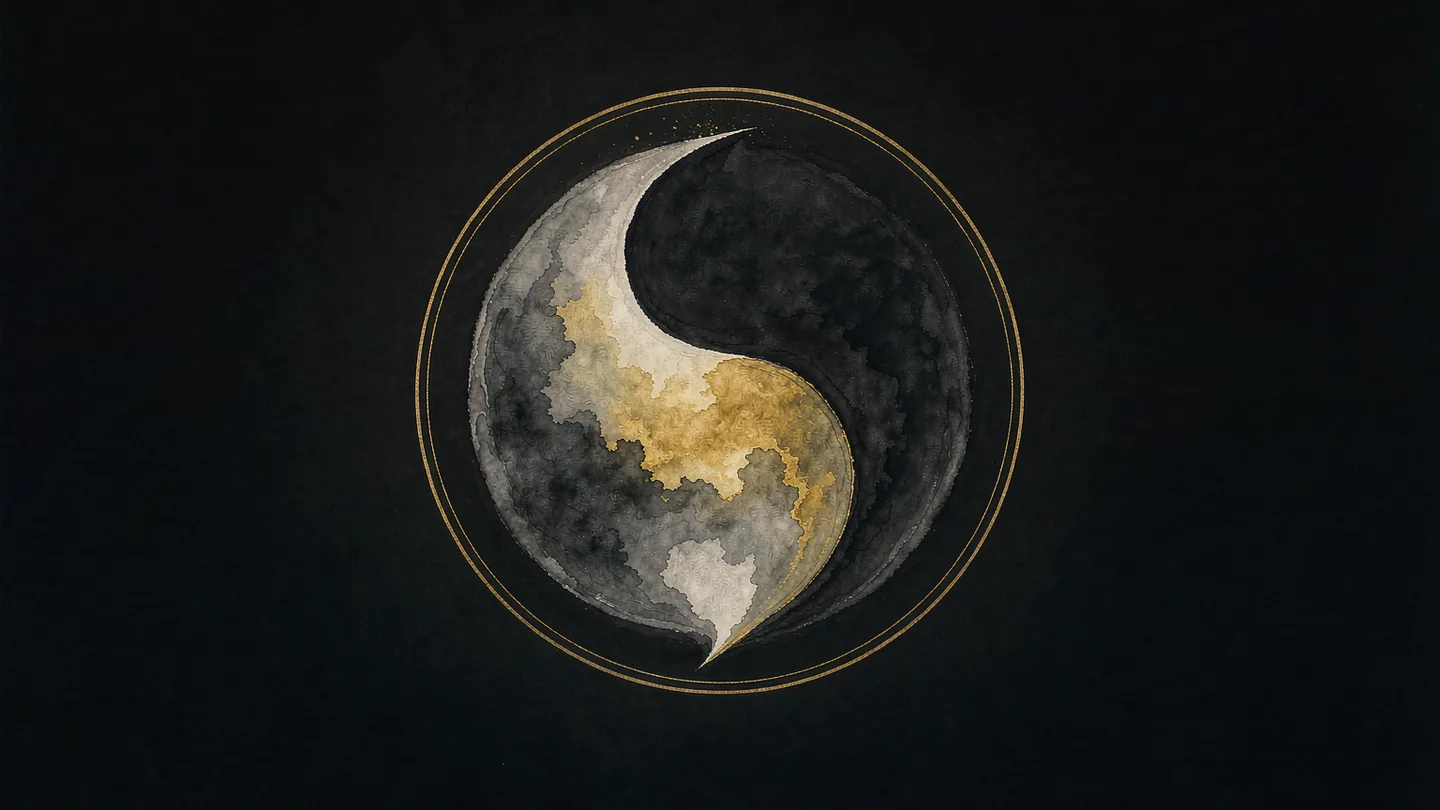
The most famous representation of Yin Yang is the Taiji symbol (太極圖) — the circle divided into swirling black and white halves, each containing a small dot of the opposite color. Every element of this symbol carries meaning:陰陽最著名的象徵就是太極圖——一個劃分為黑白兩半旋轉相融的圓形,每一半都包含著對方顏色的小點。這個圖案的每個元素都蘊含著深意:
- The circle represents wholeness and unity — all things are connected圓形代表完整與統一——萬物皆緊密相連
- The curved division shows that Yin and Yang are not static but constantly flowing into each other, like day becoming night曲線分割展現出陰與陽並非靜止,而是如白晝變為黑夜般,不斷相互流動交融
- The small dot in each half means that even at the peak of one force, the seed of its opposite already exists — midnight contains the beginning of dawn每一半中的小圓點意味著即使在一種力量達到頂峰時,其對立面的種子已然存在——子夜時分便已孕育著曙光的初現
- The equal areas show that neither force is superior; they are equally necessary相等的面積表明兩種力量並無優劣之分;兩者同等重要
This symbol is not decorative. It is a map of how reality works, according to Chinese cosmology. Every phenomenon — from the rotation of seasons to the rhythm of your heartbeat — follows this pattern of alternation and balance.這個圖案絕非裝飾。根據中國宇宙觀,它是現實世界運行規律的藍圖。每一種現象——從四季更替到心跳節律——都遵循著這種交替與平衡的模式。
Yin and Yang Qualities陰陽特質
Yin and Yang are not fixed labels but relative states. Anything can be described as Yin or Yang depending on what it is compared to. In general:陰陽並非固定的標籤,而是相對的狀態。任何事物都能根據與之比較的對象而被歸類為陰或陽。總體而言:
| Yang陽 | Yin陰 |
|---|---|
| Light, sun, daytime光明、太陽、白天 | Dark, moon, nighttime黑暗、月亮、夜晚 |
| Hot, fire, summer炎熱、火、夏天 | Cold, water, winter寒冷、水、冬天 |
| Active, outward, expanding動態、外向、擴張 | Still, inward, contracting靜態、內聚、收縮 |
| Male, heaven, sky男性、天、天空 | Female, earth, ground女性、地、地面 |
| Fast, loud, visible快速、大聲、顯性 | Slow, quiet, hidden緩慢、安靜、隱性 |
| Mind, thinking, speaking心智、思考、表達 | Body, feeling, listening身體、感受、傾聽 |
| Creation, beginning創造、開端 | Completion, ending完成、終結 |
Notice that Yin is not "bad" and Yang is not "good." They are simply different modes of being. A healthy life requires both: times of action and times of rest, times of giving and times of receiving, times of speaking and times of listening.請注意,陰並非「壞」,陽亦非「好」。兩者只是不同的存在模式。健康的生活兩者不可或缺:行動之時與休息之時、付出之時與接受之時、表達之時與傾聽之時。
The Four Principles of Yin Yang陰陽四大原則
1. Opposition1. 對立
Yin and Yang are opposite forces that compete with and restrain each other. If one becomes too strong, it suppresses the other. For example, excessive Yang (too much heat, activity, or stimulation) can burn out the body's Yin reserves, leading to exhaustion, inflammation, or insomnia.陰與陽是相互對立、競爭並制約的兩種力量。若其中一方過強,就會抑制另一方。例如,過盛的陽氣(過多的熱能、活動或刺激)會耗盡體內的陰液儲備,導致疲勞、發炎或失眠。
2. Interdependence2. 相互依存
Despite being opposites, Yin and Yang cannot exist without each other. There is no day without night, no up without down, no exhale without an inhale. In Chinese medicine, this means that bodily functions (Yang) depend on substance and nourishment (Yin), and vice versa.儘管兩者對立,陰與陽卻無法脫離彼此而獨立存在。沒有夜就沒有晝,沒有下就沒有上,沒有吸氣就沒有呼氣。在中醫學中,這意味著身體功能(陽)依賴於物質與營養(陰),反之亦然。
3. Mutual Transformation3. 相互轉化
When one force reaches its extreme, it transforms into its opposite. Summer heat eventually gives way to autumn cool. Extreme anger can collapse into exhaustion. This is why the Taiji symbol shows a dot of Yin within Yang and Yang within Yin — the seed of transformation is always present.當一種力量達到極致時,就會轉化為其對立面。盛夏的炎熱最終會讓位給深秋的涼爽;極度的怒氣可能會塌陷為精疲力竭。這就是為什麼太極圖顯示出陽中有陰點、陰中有陽點——轉化的種子永遠存在。
4. Infinite Divisibility4. 無限可分性
Within every Yin there is a smaller Yin and Yang, and within every Yang there is a smaller Yin and Yang. A summer afternoon is Yang within Yang; a summer night is Yin within Yang. This principle allows the system to describe reality at any scale, from cosmic cycles to the organs of the body.在每個陰之中,都有更小的陰與陽;在每個陽之中,亦有更小的陰與陽。夏日的午後是陽中之陽;夏日的夜晚則是陽中之陰。這一原則使該體系能夠在任何尺度上描述現實,從宇宙循環到人體器官皆然。
Yin Yang in Bazi and Chinese Astrology八字與中國占星中的陰陽
In Bazi (Four Pillars of Energy), Yin Yang is built into the system at every level. Each of the Five Elements Feng Shui has a Yin and a Yang form, creating the ten Heavenly Stems:在八字(四柱能量)中,陰陽貫穿於系統的每一個層面。五行與風水中的每一行都有陰與陽兩種形式,從而構成了十天干:
- Yang Wood (Jia) — the towering oak, upright and directive陽木(甲)—— 高聳的橡樹,挺拔而具導向性
- Yin Wood (Yi) — the climbing vine, flexible and adaptive陰木(乙)—— 攀緣的藤蔓,靈活且具適應力
- Yang Fire (Bing) — the blazing sun, radiant and constant陽火(丙)—— 熾熱的太陽,耀眼而持久
- Yin Fire (Ding) — the candle flame, warm and focused陰火(丁)—— 燭光火焰,溫暖而專注
- Yang Earth (Wu) — the mountain, immovable and enduring陽土(戊)—— 巍峨的高山,堅定不移且持久
- Yin Earth (Ji) — the fertile soil, nurturing and productive陰土(己)—— 肥沃的土壤,滋養且富生產力
- Yang Metal (Geng) — the sword, sharp and decisive陽金(庚)—— 鋒利的刀劍,銳利而果斷
- Yin Metal (Xin) — the jade, refined and precious陰金(辛)—— 溫潤的美玉,精緻而珍貴
- Yang Water (Ren) — the river, powerful and sweeping陽水(壬)—— 江河,強勁而奔騰
- Yin Water (Gui) — the mist, subtle and pervasive陰水(癸)—— 薄霧,細微而無所不在
Your Day Master — the Heavenly Stem of your birth day — tells you whether your core element is in its Yang or Yin form. This changes everything about how that element expresses itself. A Yang Wood person leads from the front like a great tree; a Yin Wood person adapts and thrives like a vine. Same element, completely different energy.你的日主——即你出生日的天干——會告訴你你的核心五行是處於陽還是陰的型態。這會徹底改變該五行的展現方式。陽木之人如大樹般率領在前;陰木之人則像藤蔓般隨遇而安、茁壯成長。相同的五行,卻是完全不同的能量。
Yin Yang Balance in Daily Life日常生活中的陰陽平衡
The principle of Yin Yang extends far beyond astrology. Here is how it shows up in everyday experience:陰陽的法則遠不止於命理學。以下是它在日常體驗中的展現方式:
- Work and rest: Work is Yang (active, outward); sleep and recovery are Yin (still, inward). Chronic overwork is excessive Yang that eventually consumes Yin, leading to burnout.工作與休息:工作屬陽(主動、外放);睡眠與恢復屬陰(靜止、內收)。長期過度工作屬於陽氣過盛,最終會耗損陰氣,導致身心俱疲。
- Diet: Spicy, fried, and grilled foods are Yang; raw, cold, and watery foods are Yin. A balanced diet mixes both according to season and individual constitution.飲食:辛辣、油炸與燒烤食物屬陽;生冷、寒涼與多水分食物屬陰。均衡的飲食會根據季節與個人體質將兩者調和。
- Relationships: Every relationship has Yang phases (pursuing, building, initiating) and Yin phases (receiving, waiting, nurturing). Problems arise when one partner is permanently stuck in one mode.關係:每段關係都有陽的階段(追求、建設、主動)與陰的階段(接受、等待、滋養)。當其中一方長期卡在單一模式時,問題便隨之產生。
- Seasons: Spring and summer are Yang (energy rises, nature expands); autumn and winter are Yin (energy descends, nature contracts). Living in harmony with these cycles means being more active in summer and more reflective in winter.季節:春夏屬陽(能量上升,萬物擴張);秋冬屬陰(能量下降,萬物收斂)。順應這些循環生活,意味著在夏季更為活躍,在冬季更多沉潛反思。
- Time of day: Morning to afternoon is Yang (best for action and decision-making); evening to night is Yin (best for rest, reflection, and creative insight).一天中的時間:早晨至下午屬陽(最適合行動與決策);傍晚至夜晚屬陰(最適合休息、反思與激發創意靈感)。
A Common Misconception常見的誤解
Many people assume Yin is "weak" and Yang is "strong." This is a fundamental misunderstanding. Yin is not weakness — it is depth. Water is Yin, but it can carve through stone. Stillness is Yin, but it is where insight and strategy are born. Some of the most powerful people in history have had strong Yin energy: patient, reflective, and able to see what others miss.許多人以為陰是「弱」,陽是「強」。這是一個根本的誤解。陰絕非軟弱——它是深度。水屬陰,卻能穿石削岩。靜止屬陰,卻是洞察力與策略孕育之處。歷史上一些最具影響力的人物都擁有強大的陰性能量:耐心、深思,並且能看見他人忽略之處。
True strength, in the Yin Yang framework, is balance — knowing when to act and when to wait, when to push forward and when to pull back, when to speak and when to listen.在陰陽的架構中,真正的力量在於平衡——懂得何時採取行動、何時耐心等待;何時奮勇向前、何時適時收斂;何時發言、何時傾聽。
Yin Yang and the Taiji Bagua陰陽與太極八卦
The Taiji symbol sits at the center of the Bagua (八卦) — the Eight Trigrams arrangement. Each trigram is made of three lines (solid for Yang, broken for Yin), representing a different combination of these two forces. Together, the Taiji and Bagua form the Taiji Bagua Diagram, one of the most recognized symbols in Chinese culture, representing the complete system of cosmic balance.太極符號位於八卦的中心。每個卦象皆由三條爻(實線為陽,斷線為陰)組成,代表這兩種力量的不同組合。太極與八卦共同構成太極八卦圖,這是中華文化中最具代表性的象徵之一,代表著宇宙平衡的完整體系。
Want to discover whether your birth chart leans more Yin or Yang? Our free calculator shows your complete elemental and polar balance.想知道您的八字命盤偏向陰還是陽嗎?我們的免費測算工具能為您顯示完整的五行與陰陽平衡。
Discover Your Yin Yang Balance探索您的陰陽平衡
Free, instant, no sign-up. See your complete Bazi chart and elemental composition.免費、即時、免註冊。查看您完整的八字命盤與五行組成。
Reveal Chart開始測算Further Reading延伸閱讀
Eight guides that continue this thread八篇接著這條線讀下去的指南- Five Elements : Personality in Chinese AstrologyDiscover the Five Elements (Wu Xing): Wood, Fire, Earth, Metal, Water. Learn each element's personality traits…五行:中華占星術中的性格分析探索五行(Wu Xing):木、火、土、金、水。了解每個五行的性格特質…
- Feng Shui Five Elements: Colors, Directions & Room GuideFeng Shui Five Elements explained: colors, directions, and room-by-room tips. Balance Wood, Fire, Earth, Metal and…風水五行:顏色、方位與房間配置指南風水五行解析:顏色、方位與各房間佈局建議。平衡木、火、土、金與…
- Bazi Four Pillars of Energy: Year, Month, Day & Hour ExplainedWhat are the Four Pillars in Bazi? What the Year, Month, Day and Hour pillars reveal about ancestry, career, self…八字四柱能量解析:年柱、月柱、日柱與時柱什麼是八字四柱?年柱、月柱、日柱與時柱如何揭示祖業、事業、自我…
- How to Read a Bazi Chart: Step-by-Step Guide for BeginnersLearn how to read a Bazi chart step by step. Understand the Four Pillars, Day Master, Ten Gods, and Luck Pillars in…如何看懂八字命盤:初學者逐步指南一步步學習如何看懂八字命盤。深入了解四柱、日主、十神與大運…
- What is Bazi?Learn what Bazi (Four Pillars of Energy) is: the Chinese birth chart using Yin Yang, Five Elements, and Eight…什麼是八字?了解什麼是八字(四柱):結合陰陽、五行與八…的中華出生命盤
- AI and Five Elements: Technology Through Chinese PhilosophyHow do AI and machine learning map onto the Daoist Five Elements? Wood as data, Fire as computation, Earth as…人工智慧與五行:從東方哲學看現代科技人工智慧與機器學習如何對應道家五行?木代表資料,火代表計算,土代表…
- Bagua Trigrams Meaning: The Eight Trigrams ExplainedDiscover the eight Bagua trigrams (Qian, Kun, Zhen, Xun, Kan, Li, Gen, Dui): their symbols, elements, personality…八卦涵義:八卦完整解析探索八卦(乾、坤、震、巽、坎、離、艮、兌):包含符號、五行、特質…
- Best Careers for Your Day MasterWhich career suits your Bazi Day Master? The ideal jobs and work styles for all 10 Day Masters, from Jia Wood…最適合您日主的職業指南哪種職業最適合您的八字日主?涵蓋從甲木開始的十天干日主之理想工作與工作風格…