Bagua Trigrams Meaning八卦卦象涵義
The eight trigrams of the Bagua are the building blocks of Chinese cosmology. Each one encodes a natural force, a personality archetype, and a philosophical principle.八卦是中國宇宙觀的基石。每一個卦象都蘊含著一種自然力量、一種人格原型與一套哲學道理。
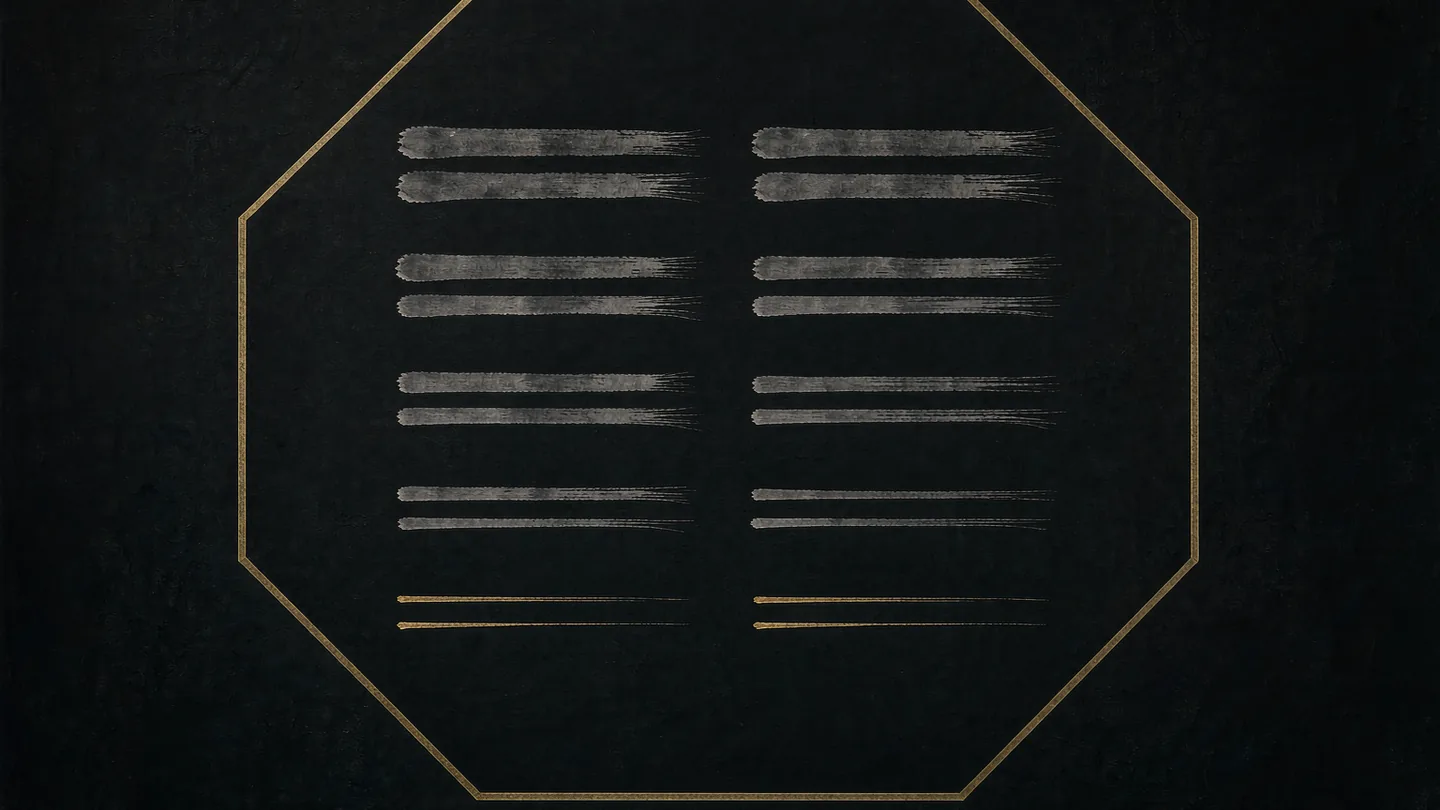
What Are the Eight Trigrams?什麼是八卦?
The word Bagua (八卦) literally means "eight symbols." Each symbol — called a trigram — is made of three horizontal lines stacked on top of each other. A solid line (—) represents Yang energy, and a broken line (– –) represents Yin energy. With three lines and two states, there are exactly 2³ = 8 possible combinations.「八卦」(八卦)字面上的意思就是「八個符號」。每一個符號——稱為一個卦——都是由三條重疊的橫線所組成。實線(—)代表陽氣,斷線(– –)代表陰氣。由三爻與兩種狀態,恰好能產生 2³ = 8 種可能的組合。
The trigrams originate from the I Ching (Book of Changes), one of the oldest Chinese texts, dating back over 3,000 years. According to legend, the legendary ruler Fu Xi discovered them by observing the patterns of nature — the movements of stars, the flow of rivers, the habits of animals.八卦源自中國最古老典籍之一的《易經》(Book of Changes),已有超過 3,000 年歷史。傳說上古帝王伏羲透過觀察大自然的規律——星辰的運轉、河流的奔流、動植物的習性——創製了八卦。
Together, the eight trigrams form the Taiji Bagua Diagram — the iconic octagonal arrangement with the Yin-Yang symbol at its center. This diagram is one of the most recognized symbols of Chinese philosophy worldwide.這八個卦象共同構成太極八卦圖——即中央帶有陰陽雙魚圖案、標誌性的八角形圖樣。這幅圖像是全球最具辨識度的中國哲學標誌之一。
The Eight Trigrams in Detail深入解析八卦
Each trigram corresponds to a natural phenomenon, a family member, a body part, an animal, a direction, and a season. Below are all eight, with their core meanings:每一個卦象都對應著一種自然現象、一位家庭成員、一個身體部位、一種動物、一個方位與一個季節。以下為八卦及其核心涵義:
Two Arrangements: Before Heaven and After Heaven兩種排列:先天八卦與後天八卦
The eight trigrams can be arranged in two different orders, each with its own meaning:八卦可以依據兩種不同的順序進行排列,各自代表著不同的涵義:
Fu Xi (Earlier Heaven / Xian Tian)伏羲(先天八卦 / Xian Tian)
In this arrangement, opposite trigrams are perfect complements: Qian (Heaven) faces Kun (Earth), Li (Fire) faces Kan (Water), Zhen (Thunder) faces Xun (Wind), and Gen (Mountain) faces Dui (Lake). This represents the ideal, balanced state of the universe — a snapshot of cosmic harmony before time began.在此排列中,相對的卦象呈現完美的互補:乾(天)對坤(地)、離(火)對坎(水)、震(雷)對巽(風)、艮(山)對兌(澤)。這象徵著宇宙最理想、最平衡的狀態——即時間開始之前宇宙和諧的定格景象。
King Wen (Later Heaven / Hou Tian)文王(後天 / Hou Tian)
This arrangement reflects the cycle of time and seasons. It shows how energy actually flows through the year: Thunder awakens in spring (East), Fire peaks in summer (South), Lake harvests in autumn (West), and Water rests in winter (North). This is the arrangement used in Feng Shui and most practical applications.此排列反映了時間與季節的循環。它展現了氣(能量)在一年四季中的實際流動:春季雷動於東、夏季火旺於南、秋季澤收於西、冬季水藏於北。這是風水學及多數實用領域中所採用的排列方式。
The Trigrams and the Five Elements八卦與五行
Each trigram is associated with one of the Five Elements Feng Shui:每個卦都對應著五行與風水:
| Trigram卦 | Symbol符號 | Element五行 | Natural Force自然力量 |
|---|---|---|---|
| Qian乾 | ☰☰ | Metal金 | Heaven天 |
| Kun坤 | ☷☷ | Earth土 | Earth土 |
| Zhen震 | ☳☳ | Wood木 | Thunder雷 |
| Xun巽 | ☴☴ | Wood木 | Wind風 |
| Kan坎 | ☵☵ | Water水 | Water水 |
| Li離 | ☲☲ | Fire火 | Fire火 |
| Gen艮 | ☶☶ | Earth土 | Mountain山 |
| Dui兌 | ☱☱ | Metal金 | Lake澤 |
Notice that Metal and Earth each have two trigrams, while Wood, Fire, and Water have one. This is because Metal represents both the hard structure of Heaven (Qian) and the reflective joy of Lake (Dui), while Earth encompasses both the vast receptivity of Earth itself (Kun) and the quiet solidity of Mountain (Gen).請注意,金與土各對應兩個卦,而木、火、水則各對應一個卦。這是因為金既代表天(乾)的堅固結構,也代表澤(兌)的喜悅映照;而土則兼具地(坤)本身的廣大包容,以及山(艮)的寧靜穩固。
The Bagua in Bazi and Personality八卦在八字與性格中的應用
In Bazi (Four Pillars of Energy), the trigrams provide an additional layer of interpretation. The Taiji Bagua Diagram at the center of the Bagua represents the interplay of Yin and Yang Day Master that animates all of life.在八字(能量四柱)中,八卦提供了額外的解析層次。位於八卦中心的太極八卦圖代表著賦予萬物生機的陰陽與日主互動。
Your birth chart's elemental balance can be mapped to the trigrams. For example:你命盤中的五行平衡可以對應到八卦。例如:
- A person with strong Metal and leadership qualities resonates with Qian (Heaven)金氣強旺且具備領導特質的人,會與乾(天)產生共鳴
- A nurturing, supportive personality resonates with Kun (Earth)具備滋養、包容支持性格的人,會與坤(地)產生共鳴
- A restless, change-making personality resonates with Zhen (Thunder)性格積極不安於現狀、勇於開創新局的人,會與震(雷)產生共鳴
- A calm, meditative personality resonates with Gen (Mountain)性格平靜沉穩、喜好冥想的人,會與艮(山)產生共鳴
Understanding your dominant trigram adds a new dimension to self-awareness. It tells you not just what elements you have, but how your energy naturally moves through the world.了解你的主導卦象能為自我認知增添全新維度。它不僅告訴你擁有什麼五行,還揭示了你的能量如何在世界上自然流動。
The Bagua in Feng Shui八卦在風水中的應用
Beyond Bazi, the Bagua is central to Feng Shui — the Chinese art of spatial harmony. The King Wen arrangement is used as a map overlaid on homes, rooms, and gardens. Each of the eight sectors corresponds to a life area:除了八字之外,八卦更是風水(空間和諧的中國藝術)的核心。後天八卦(文王卦位)被用作覆蓋住宅、房間與花園的圖譜。八個方位中的每一個都對應著人生的不同領域:
| Direction方位 | Trigram卦 | Life Area人生領域 |
|---|---|---|
| North北 | Kan (Water)坎(水) | Career & Life Path事業與人生歷程 |
| Northeast東北方 | Gen (Mountain)艮(山) | Knowledge & Self-Cultivation知識與自我修養 |
| East東 | Zhen (Thunder)震(雷) | Family & Health家庭與健康 |
| Southeast東南方 | Xun (Wind)巽(風) | Wealth & Abundance財富與豐盛 |
| South南 | Li (Fire)離(火) | Fame & Reputation名聲與聲望 |
| Southwest西南方 | Kun (Earth)坤(地) | Love & Marriage愛情與婚姻 |
| West西 | Dui (Lake)兌(澤) | Children & Creativity子女與創造力 |
| Northwest西北 | Qian (Heaven)乾(天) | Helpful People & Travel貴人與出行 |
Binary Code and the Trigrams二進位碼與八卦
There is a fascinating mathematical connection between the Bagua trigrams and binary numbers. If we treat a solid Yang line as 1 and a broken Yin line as 0, each trigram maps to a three-digit binary number:八卦與二進位數字之間存在著令人著迷的數學聯繫。如果我們將陽爻(實線)視為 1,陰爻(虛線)視為 0,每個卦象都可以對應到一個三位的二進位數字:
| Trigram卦 | Lines (bottom to top)爻(由下至上) | Binary二進位 | Decimal十進位 |
|---|---|---|---|
| Kun (Earth)坤(地) | 0 0 00 0 0 | 000000 | 00 |
| Zhen (Thunder)震(雷) | 1 0 01 0 0 | 001001 | 11 |
| Kan (Water)坎(水) | 0 1 00 1 0 | 010010 | 22 |
| Dui (Lake)兌(澤) | 1 1 01 1 0 | 011011 | 33 |
| Gen (Mountain)艮(山) | 0 0 10 0 1 | 100100 | 44 |
| Xun (Wind)巽(風) | 1 0 11 0 1 | 101101 | 55 |
| Li (Fire)離(火) | 0 1 10 1 1 | 110110 | 66 |
| Qian (Heaven)乾(天) | 1 1 11 1 1 | 111111 | 77 |
The philosopher Leibniz, who co-invented the binary number system in the 17th century, was astonished when he learned about the I Ching trigrams. He saw them as proof that binary logic was a universal principle — discovered independently in both East and West.哲學家 萊布尼茲 在 17 世紀共同發明了二進位制,當他得知《易經》八卦時感到非常震驚。他將其視為二進位邏輯乃普世原理的證明——在東西方各自獨立被發現。
The 64 Hexagrams六十四卦
When you combine any two trigrams — one above and one below — you get a hexagram (six lines). With 8 trigrams in the upper position and 8 in the lower, there are 8 × 8 = 64 hexagrams. These 64 hexagrams form the core of the I Ching and represent every possible state of change in the universe.當你將任意兩個卦組合在一起——一上一下——就會得到一個卦(六爻)。上卦有 8 種可能,下卦有 8 種可能,共有 8 × 8 = 64 卦。這 64 卦構成了《易經》的核心,象徵著宇宙中每一種可能的變化狀態。
Each hexagram has a name, a judgment, and a commentary. Together, they describe a complete philosophy of transformation: how situations arise, develop, reach a peak, and transform into something new. The 64 hexagrams are one of the world's oldest systems for understanding change.每一卦都有卦名、卦辭與註解。它們共同描述了一套完整的變化哲學:事物如何興起、發展、達到頂峰,並轉化為新的型態。六十四卦是世界上最古老的理解變化系統之一。
The Trigram Family: Who's Who in the Bagua八卦家庭:八卦中的角色關係
Classical texts describe the eight trigrams as a family. Qian (Heaven) is the father and Kun (Earth) is the mother. Their three sons and three daughters complete the household. This is not decoration — the family role tells you how each trigram's energy behaves:典籍將八卦比作一個家庭。乾(天)為父,坤(地)為母。他們的三男三女組成了這個大家庭。這並非只是裝飾性的比喻——家庭角色揭示了每個卦象的氣如何運作:
| Trigram卦 | Family Role家庭角色 | Energy Pattern能量模式 | Body Part身體部位 |
|---|---|---|---|
| Qian (Heaven)乾(天) | Father父 | Initiates, leads, creates開創、主導、創造 | Head頭部 |
| Kun (Earth)坤(地) | Mother母 | Receives, nurtures, completes包容、滋養、成就 | Belly腹 |
| Zhen (Thunder)震(雷) | Eldest Son長男 | Awakens, moves, startles覺醒、震動、驚起 | Feet足 |
| Kan (Water)坎(水) | Middle Son中男 | Persists, risks, dives deep持續、涉險、深潛 | Ears耳 |
| Gen (Mountain)艮(山) | Youngest Son少男 | Stops, stills, meditates靜止、停歇、冥想 | Hands手 |
| Xun (Wind)巽(風) | Eldest Daughter長女 | Penetrates, spreads gently滲透、柔和擴散 | Thighs股 |
| Li (Fire)離(火) | Middle Daughter中女 | Illuminates, attaches, clings照亮、附著、依附 | Eyes目 |
| Dui (Lake)兌(澤) | Youngest Daughter少女 | Delights, exchanges, speaks喜悅、交流、言說 | Mouth口 |
Notice the pattern: the sons are trigrams with one Yang line among Yin (movement breaking through stillness), and the daughters are trigrams with one Yin line among Yang (receptive space within movement). The position of that single line determines whether the child is eldest, middle, or youngest — a beautiful example of how the Bagua encodes relationships through pure line logic.注意這個規律:諸子(男卦)是眾陰之中包含一陽爻的卦(以動破靜),諸女(女卦)則是眾陽之中包含一陰爻的卦(動中的順應空間)。那唯一一條爻的位置決定了子女是長、中還是幼——這完美展現了八卦如何透過純粹的爻線邏輯來編碼親屬關係。
Frequently Asked Questions常見問題
What does Bagua mean in English?八卦在英文中是什麼意思?
Bagua (八卦) translates to "eight symbols" or "eight trigrams." Ba means eight; Gua means a divination symbol made of stacked lines. The full Taiji Bagua Diagram shows the eight trigrams arranged in a circle around the Yin Yang symbol — one of the most iconic images of Chinese cosmology.Bagua(八卦)翻譯為「八個符號」或「八卦」。「八」代表數字八;「卦」代表由爻堆疊而成的占卜符號。完整的太極八卦圖展示了圍繞陰陽符號排列成圈的八個卦象——這是中華宇宙觀中最具代表性的圖騰之一。
Is the Bagua a religious symbol?八卦是宗教符號嗎?
No. The Bagua is a philosophical and cosmological model, not a religious icon. It belongs to the same family of ideas as Yin Yang and the Five Elements — a framework for describing how energies interact. It appears in Daoist, Confucian, and even secular contexts, from the I Ching to Korean and Japanese flags' symbolism.不是。八卦是一個哲學與宇宙觀的模型,而非宗教圖騰。它與陰陽、五行屬於同一個思想體系——一個用來描述能量如何相互作用的框架。從《易經》到韓國和日本國旗的象徵意義,八卦廣泛出現於道家、儒家乃至世俗情境中。
Why do the trigrams point in different directions in different diagrams?為什麼八卦在不同的圖解中指向不同的方向?
Because there are two classic arrangements. The Earlier Heaven (Fu Xi) sequence places trigrams in their ideal, balanced positions — opposites facing each other. The Later Heaven (King Wen) sequence places them in the order of natural change and seasonal flow. Most Feng Shui applications and modern depictions of the Taiji Bagua Diagram use the King Wen arrangement.因為有兩種經典排列方式。先天八卦(伏羲)方位將卦放在理想且平衡的位置——相對的卦彼此相向。後天八卦(文王)方位則按自然變化與季節流轉的順序排列。大多數風水應用以及現代的太極八卦圖描繪,都採用文王後天八卦的排列。
Can I use the Bagua without knowing Bazi?我可以在不懂八字的情況下使用八卦嗎?
Yes. The Bagua stands on its own in Feng Shui, meditation, and the I Ching. But if you want to know which trigram energies dominate your personality, your Bazi chart's Five Element balance is the fastest way to find out — and it takes about thirty seconds with a free calculator.可以。八卦在風水、冥想與《易經》中皆可獨立運作。但如果您想了解哪些卦象能量主導了您的性格,八字命盤中的五行平衡是最快找到答案的方法——使用免費測算器只需要大約三十秒。
Discover Your Own Bagua Chart探索您自己的八卦圖
Want to see which elements and trigram energies are strongest in your birth chart? Our free calculator generates your complete Bazi chart, including your Day Master, Five Element balance, and personalized personality reading based on the Taiji Bagua system.想知道您的出生命盤中哪些五行與卦象能量最強嗎?我們的免費測算器能生成您完整的八字命盤,包含您的日主、五行平衡,以及基於太極八卦系統的個人化性格分析。
Get Your Free Bagua Birth Chart獲取您的免費八卦出生命盤
No sign-up. No data collection. All calculations happen in your browser.無需註冊。不收集資料。所有計算均在您的瀏覽器中進行。
Reveal Chart開始測算Further Reading延伸閱讀
Eight guides that continue this thread八篇接著這條線讀下去的指南- Five Elements : Personality in Chinese AstrologyDiscover the Five Elements (Wu Xing): Wood, Fire, Earth, Metal, Water. Learn each element's personality traits…五行:中華占星術中的性格分析探索五行(Wu Xing):木、火、土、金、水。了解每個五行的性格特質…
- Feng Shui Five Elements: Colors, Directions & Room GuideFeng Shui Five Elements explained: colors, directions, and room-by-room tips. Balance Wood, Fire, Earth, Metal and…風水五行:顏色、方位與房間配置指南風水五行解析:顏色、方位與各房間佈局建議。平衡木、火、土、金與…
- What is Bazi?Learn what Bazi (Four Pillars of Energy) is: the Chinese birth chart using Yin Yang, Five Elements, and Eight…什麼是八字?了解什麼是八字(四柱):結合陰陽、五行與八…的中華出生命盤
- Yin and Yang MeaningWhat is Yin and Yang? Learn the meaning of the Taiji symbol, the difference between Yin and Yang, and how this…陰陽的涵義什麼是陰陽?了解太極圖的涵義、陰與陽的差異,以及其如何…
- Bazi Compatibility: How to Match Charts for Love & MarriageLearn Bazi compatibility: how Four Pillars, Day Masters, Heavenly Stems, and Earthly Branches reveal relationship…八字合婚配對:如何合盤看愛情與婚姻深入了解八字合婚:四柱、日主、天干與地支如何揭示感情關係…
- Bazi Lucky Colors & Numbers: How They Map to the Five ElementsHow colours and numbers are associated with the five elements in Chinese astrology: your birth element's colors, your zodiac animal's lucky…八字幸運顏色與數字:依五行與生肖找出你的幸運色與數字探索你在傳統命理中的幸運顏色與數字:本命五行顏色、生肖幸運…
- Chinese New Year Animal Personalities: 12 Zodiac Traits ExplainedDiscover your Chinese New Year animal personality. Complete guide to 12 zodiac traits: Rat, Ox, Tiger, Rabbit…農曆生肖性格:十二生肖特質解析探索您的農曆生肖性格。十二生肖特質完整指南:鼠、牛、虎、兔…
- Chinese Astrology vs Western Astrology: Key DifferencesCompare Chinese astrology (Bazi, Four Pillars) with Western astrology (zodiac signs, planets). Key differences in…中國占星與西洋占星:主要差異比較中國占星(八字、四柱)與西洋占星(星座、行星)。主要差異在於…